
European landmark estates. New custodians.
Castles for sale: Mazovia
Medieval castle, Castle, Manor house, Period mansion, Urban palace, Monastery
Castles for sale: Mazovia
Manor and noble houses around Warsaw
Alongside the voivodeships of Greater Poland and Lower Silesia, Masovia is the third region with an exceptionally high density of manor houses and historic residences. In Warsaw alone, there were more than 100 palaces before 1945, the majority of which have since been rebuilt. Today they are distributed along the Royal Route (Trakt Królewski
), one of the most important cultural axes of the Polish capital.
At the beginning of the 20th century, villas and summer residences of Warsaw’s bourgeoisie emerged in the wooded small towns around the city. Places such as Konstancin-Jeziorna, Milanówek and Podkowa Leśna are now established residential and property markets in the region. Alongside large magnate palaces, the surrounding countryside also features numerous smaller residences of the landed gentry.
In Poland, the term Pałac refers both to castles and to larger representative manor houses; Dwór denotes smaller manor houses up to entire estate complexes with agricultural buildings. In the Masovian region, another form is particularly common: the Dworek
is a residence of the Polish landed gentry, often built on the remains of earlier estates. In the 19th century, these houses gradually lost their agricultural function and became social and cultural meeting places for the rural nobility.
Architecturally, the classic Dworek is a long, typically single-storey building with a narrow portico and a triangular pediment. A well-known example is the birthplace of Frédéric Chopin in Żelazowa Wola.
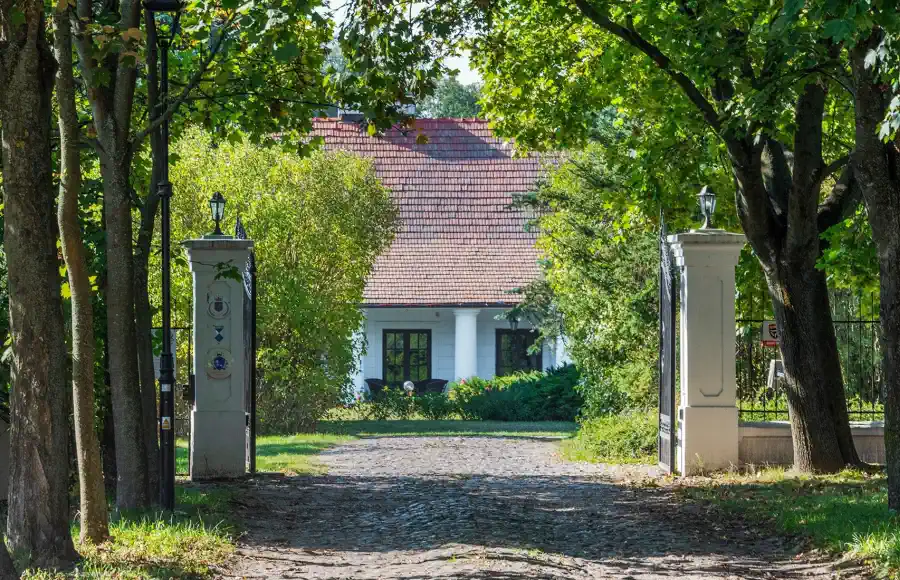
Dworek: Country houses of the landed gentry shape the Masovia region